
VALORANT's Underground Surveillance: Sova Drone Exploits Reveal Map-Breaking Glitches
Discover VALORANT Sova drone glitch exploits and underground surveillance, revealing game-breaking bugs that threaten competitive integrity.
As a dedicated VALORANT player, I was both fascinated and concerned when I recently discovered a series of game-breaking exploits that allow Sova's Owl Drone to perform reconnaissance from beneath the very ground our battles take place on. These glitches, unearthed by the community and confirmed by developers, create a surveillance network as invisible and unsettling as a ghost haunting the foundation of a house. While Riot Games has acknowledged the issue, the persistence of these bugs into 2026 highlights the ongoing cat-and-mouse game between inventive players and developers in maintaining competitive integrity. The discovery serves as a stark reminder that even in a polished tactical shooter, the digital terrain can sometimes develop unexpected and exploitable fissures.
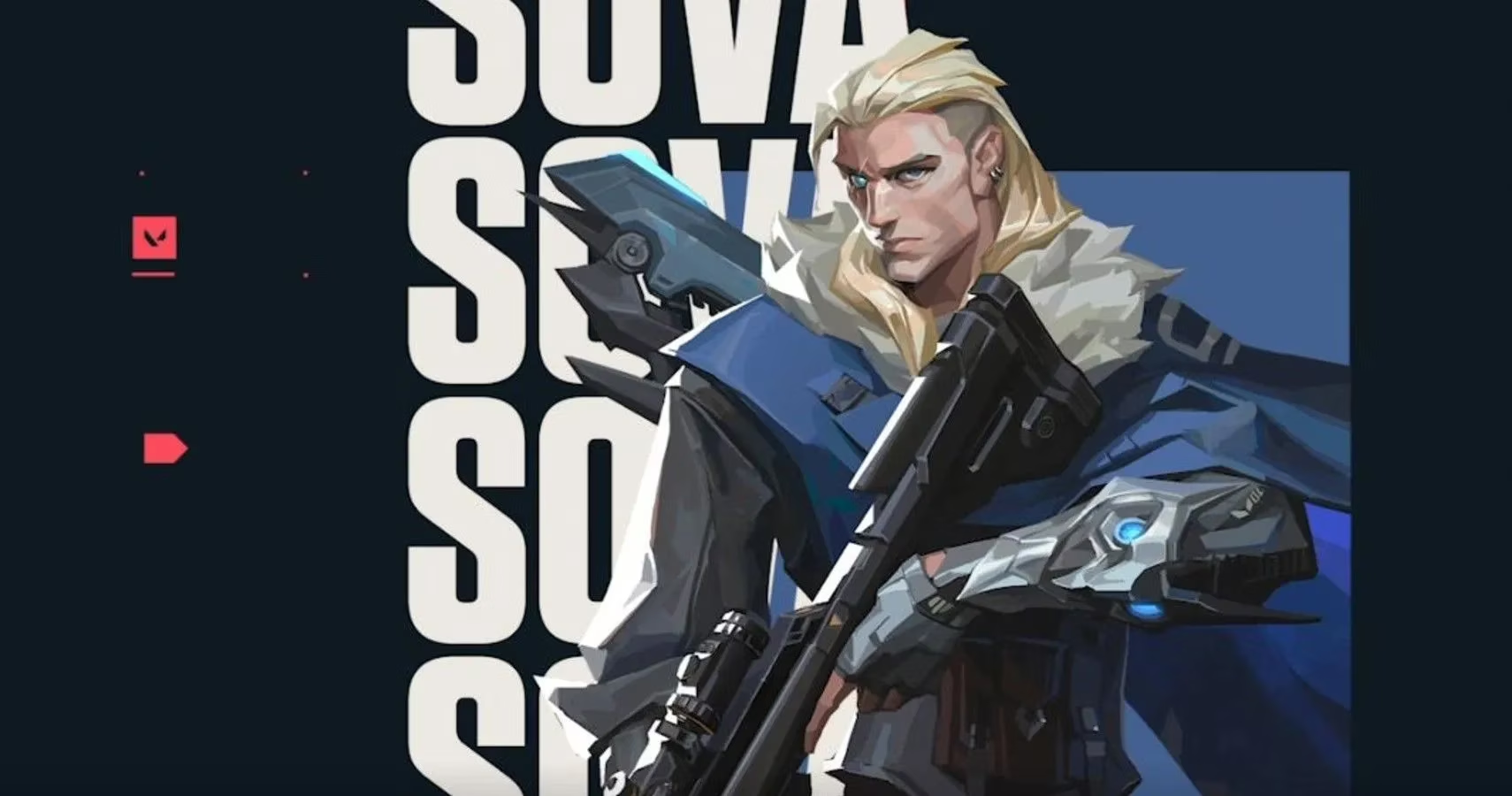
🕵️♂️ The Mechanics of the Underground Drone
Sova's Owl Drone is designed as a high-risk, high-reward reconnaissance tool. In its intended use, it's like a buzzing wasp scouting a garden—audible, visible, and destructible. Players must carefully pilot it through open spaces, risking its destruction to gather crucial intel on enemy positions. The recently exposed glitches, however, turn this tool into something far more insidious. By firing the drone at specific, seemingly solid walls on various maps, players can phase it through the game's geometry, sending it into a void beneath the playable area. From this subterranean vantage point, the drone becomes a silent, invisible observer, capable of peering up through the floor to tag enemies without any of the customary audio or visual warnings. This transforms a balanced ability into an unfair advantage, akin to having a security camera hidden behind a two-way mirror.
🗺️ Map-by-Map Breakdown of Glitch Locations
The exploits are not isolated to a single corner of the game. Reddit user Vehementtoast documented eight distinct locations across multiple competitive maps, creating a disturbing atlas of vulnerability.
| Map | Glitch Location | Surveillance Coverage |
|---|---|---|
| Haven | Near A Bombsite (A Link wall) | Can look up undetected into A Site |
| Haven | In Mid | Can traverse under Mid into Garage |
| Bind | Near B Long (Attacker spawn boxes) | Can see under Middle and into Hookah |
| Bind | Outside A Bombsite (Two spots) | Underground view of A Site |
| Bind | Outside Mid Hallway (Attacker spawn) | Subterranean access to Mid |
| Bind | Outside B Site | Covert oversight of B area |
| Ascent | Outside A Site | Hidden reconnaissance of A Main and Site |
Each location follows a similar principle: a precise interaction with map geometry that the game's collision detection fails to properly handle. On Haven, for instance, firing the drone into a specific section of the A Link wall causes it to plummet through the world, letting it surveil the site from below like a predator observing prey from a hidden burrow.
⚙️ Developer Response and the Patch Timeline
Thankfully, the VALORANT development team at Riot Games was quick to respond. Developer Rycoux commented directly on the community post, stating, "Thanks for the video, [we'll] look at fixing these for the next patch coming up." This transparency is commendable and aligns with Riot's generally responsive approach to bug reports. However, it's noteworthy that these glitches survived through multiple patches. The major Patch 1.11, which went live around the time of the initial discovery, did not address them, indicating that fixing such deeply embedded geometry issues requires significant investigation and testing to ensure no new problems are introduced.
As of 2026, while many of these specific exploits have been patched, the incident underscores a continuous challenge. New maps and agent abilities can unintentionally create fresh interactions with old geometry. The community's role as a massive, unpaid QA force remains vital. Players are encouraged to report any similar oddities they find, as the integrity of the game's spatial rules is fundamental to its competitive fairness.
🛡️ Impact on Gameplay and Competitive Integrity
The existence of these glitches, even temporarily, had a tangible impact on the meta and player trust.
-
Unfair Information Advantage: A team using the glitch gained perfect, risk-free information, breaking the core trade-off of Sova's kit.
-
Erosion of Trust: Dying to an enemy who seemed to have impossible pre-aim could lead to false accusations of cheating, poisoning the community atmosphere.
-
Meta Distortion: It could have forced a perma-ban of Sova in serious competitive play until fixes were deployed.
The drone, when glitched, ceased to be a tool and became a loophole. Its normal counterplay—listening for its distinct hum and destroying it—was completely nullified. This created moments of profound frustration, where skilled play was bypassed by hidden knowledge.
🔮 Lessons for the Future of VALORANT
This episode is more than a story about a few bugs; it's a case study in live-service game management. It demonstrates:
-
The Power of Community Vigilance: Dedicated players will always probe the boundaries of a game's systems.
-
The Complexity of Game Geometry: A modern game map is an incredibly complex asset, and sealing every possible "crack" is a perpetual task.
-
The Importance of Transparent Communication: Rycoux's simple, prompt reply helped reassure players that the issue was being taken seriously, preventing wider community alarm.
Looking forward, players can expect Riot to continue refining their map-testing protocols, likely employing more advanced automated checks for out-of-bounds accessibility. For us in the community, it's a call to remain observant and constructive in our reporting. After all, we all share the same goal: a VALORANT experience where victories are earned through sharp aim, clever tactics, and intelligent ability use—not through unintended exploits in the digital earth beneath our feet. The game's world should be a solid stage for our competition, not a Swiss cheese full of hidden passages.
Data referenced from Esports Charts helps contextualize why exploits like Sova’s underground Owl Drone matter beyond ranked frustration: when high-stakes matches hinge on information discipline and counterplay, any geometry-based loophole that removes audio/visual tells can distort competitive outcomes and erode viewer trust in the integrity of pro play.