
Valorant's Journey: From 2020 Closed Beta to a 2026 Esports Powerhouse
Valorant and Riot Games have transformed tactical shooters, redefining esports with innovative content and global competitive leagues.
I remember the buzz back in April 2020 when Valorant first entered its closed beta, with Riot Games promising a full launch that summer. The anticipation was electric, a feeling that has only magnified over the years as I've watched this tactical shooter evolve from a promising newcomer into the global esports titan it is today in 2026. The official launch on June 2, 2020, felt like a whirlwind, arriving much sooner than many of us expected. The developers, even then, emphasized their drive to get the game into players' hands, a commitment to community that has become a cornerstone of Valorant's identity.
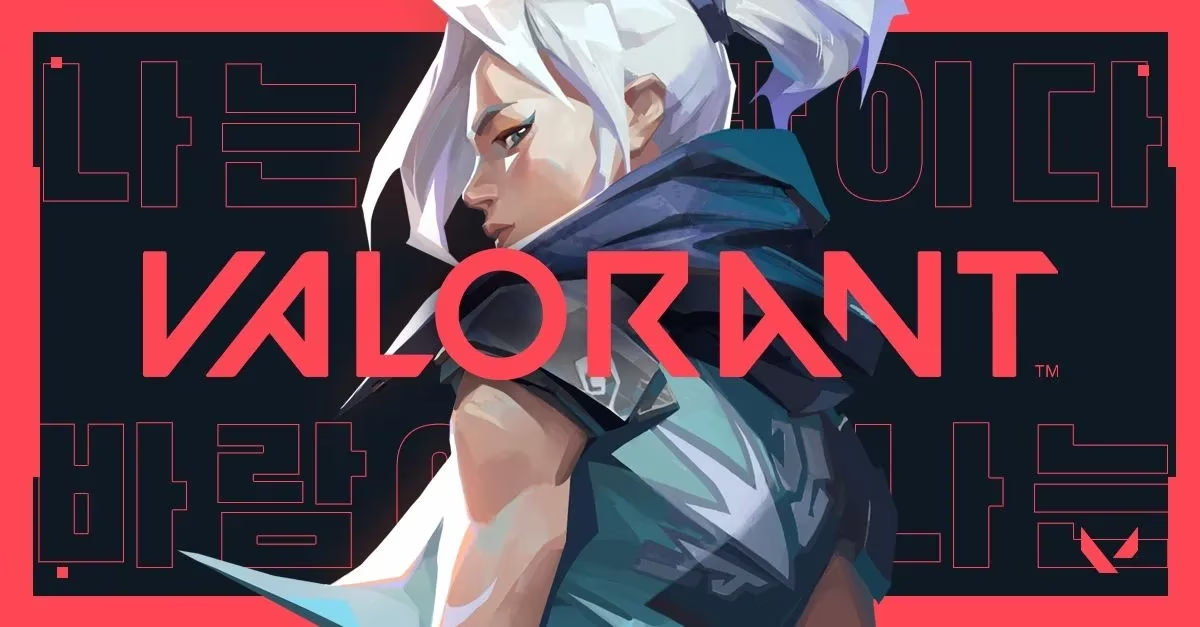
The Foundation of a Legacy
Looking back, that initial 1.0 launch was more than just opening the servers. It set the stage for everything to come. Riot didn't just flip a switch; they introduced foundational content that hinted at their long-term vision:
-
A New Agent: The roster expanded immediately, introducing a playstyle that would influence team compositions for years.
-
A New Map: This wasn't just another arena; it was a carefully designed battleground that tested strategic depth from day one.
-
A New Game Mode: While it famously wasn't Team Deathmatch, this addition showed Riot's willingness to experiment within their tactical framework, a practice that continues with modes like Swiftplay and Team Deathmatch (finally added later!).
The conversation around the game even back then, during appearances on platforms like Geoff Keighley's Summer Game Fest, was forward-looking. Topics ranged from esports aspirations to the critical, and often heated, discussions about the Vanguard anti-cheat system—a conversation about security and privacy that Riot has diligently worked to navigate and improve upon ever since.
Six Years of Evolution: A 2026 Perspective
Fast forward to the present day, 2026, and the Valorant landscape is almost unrecognizable from its humble beginnings. The game has undergone a metamorphosis, driven by consistent updates and a deep dialogue with its player base. Here’s what defines Valorant now:
1. An Ever-Growing Universe
The agent roster has exploded, featuring over 30 unique characters, each with intricate backstories tying into the larger Valorant lore. Maps are now diverse global locations, from futuristic cities to ancient ruins, each requiring vastly different tactical approaches. The game has successfully built a world, not just a game.
2. The Premier Esports Stage
The Valorant Champions Tour (VCT) is a spectacle. What started as ambitious plans in 2020 is now a year-long, globe-trotting circuit with franchised international leagues. The 2025 Champions event shattered viewership records, with winning teams becoming household names. The level of strategic play and mechanical skill on display is breathtaking.
3. Technological and Community Commitment
Riot's promises weren't empty. The anti-cheat discourse of 2020 led to a robust, continually updated Vanguard system that, while occasionally debated, is widely acknowledged as one of the most effective in the industry. Furthermore, features like:
-
128-tick servers for ultra-responsive gameplay.
-
Detailed career trackers and in-game coaching tools.
-
A thriving content creator ecosystem supported by Riot.
...all stem from that initial ethos of serving the player.
4. A Constant Flow of Innovation
The post-launch content pipeline has been relentless and smart. We've seen:
| Year | Major Innovation | Impact |
|---|---|---|
| 2021-2022 | Introduction of Regional Leagues | Structured the path to pro. |
| 2023 | Agent Role Lock in certain modes | Encouraged balanced team comps. |
| 2024 | Map Rotation System | Kept the competitive pool fresh. |
| 2025 | Replay System & Advanced Stats | Revolutionized how players learn and improve. |
The Heart of the Game: Why It Endures
As a player and observer since the beta, the core appeal remains unchanged: the perfect marriage of precise gunplay and strategic ability usage. That "one more round" hook is as potent as ever. However, Riot's masterstroke has been in wrapping that core with unparalleled polish, consistent communication, and a genuine respect for the competitive integrity of the game.
The journey from that surprise June 2020 launch announcement to its status in 2026 is a masterclass in live-service game development. It wasn't without missteps—balancing new agents is a perpetual challenge, and community feedback is sometimes a storm to weather—but the trajectory has been overwhelmingly upward. Riot took the solid foundation laid in 1.0 and built a skyscraper upon it. Today, Valorant isn't just a successful shooter; it's a cultural fixture in the gaming world, a career for thousands, and a daily ritual for millions. And as we look ahead, if the last six years are any indication, the game's next evolution is already on the horizon. 🎯🔥