
The Ascent Leak of 2020: A Valorant Player's Memory Lane
Valorant Ascent map leak captivated FPS fans with tactical depth, Venetian charm, and unique door mechanics for competitive play.
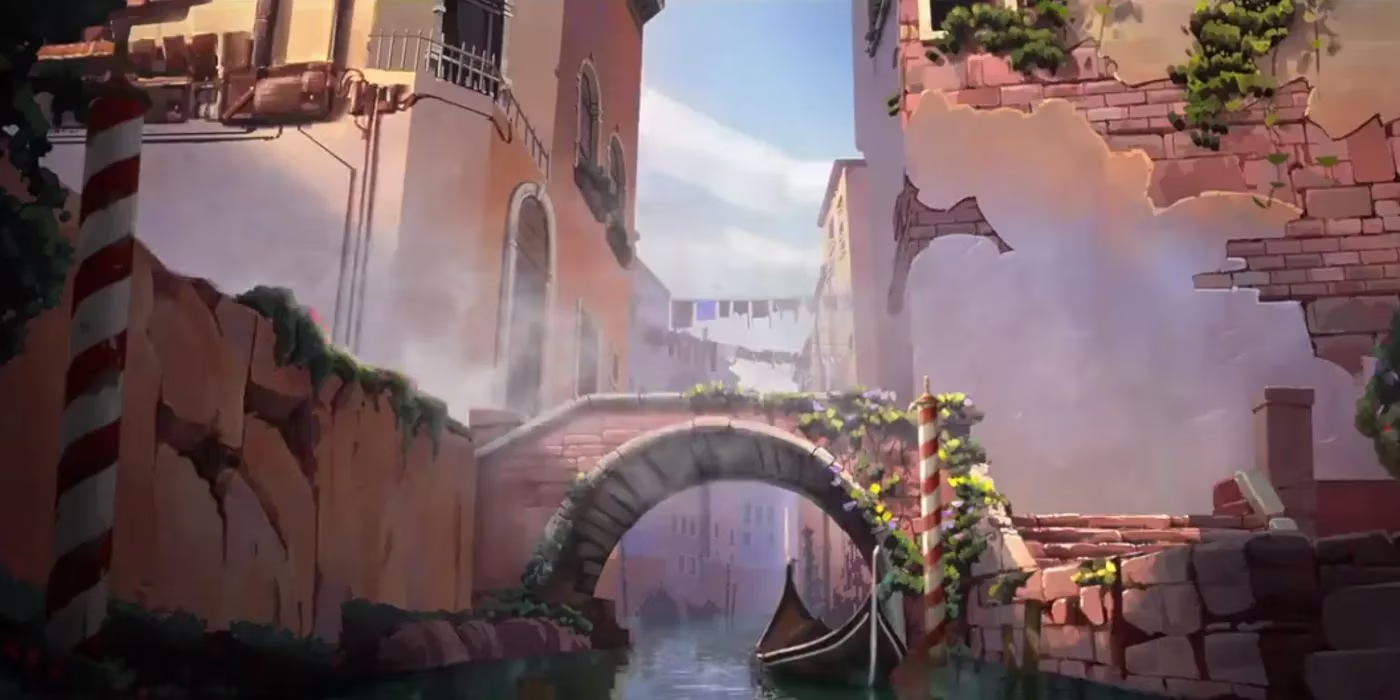
I still remember the spring of 2020 like it was yesterday—Valorant’s closed beta had just dropped, and the whole gaming world was losing its collective mind. As a competitive FPS junkie, I’d been glued to Twitch streams, soaking in every pixel of Riot’s new tactical shooter. Then, out of the blue, a Reddit post hit the front page with something that truly blew my socks off: a datamined leak of a brand-new map named Ascent. Back then, the only maps we had were Haven, Bind, and Split, so the prospect of a fourth map sent the community into a frenzy. I couldn’t believe my eyes scrolling through those screenshots—a Venetian-themed playground with canals, gondolas, and even a pizzeria. This was the real deal, straight from the game files.
The leaked minimap revealed a layout full of tight corridors, cubby holes, and two bomb sites (A and B) connected by a distinctive mid area. I remember squinting at that image, trying to deduce angles and holding spots. Compared to the existing maps, Ascent looked like it had more nooks and crannies—a nightmare for spray-and-pray players but a dream for those of us who loved methodical, utility-heavy play. The community was buzzing with theories: would the canals be playable water? Could we ride the gondolas? (Spoiler: we couldn’t, but a boy can dream.) The leak was the talk of every Discord server and stream chat, and I was all in, checking for updates every day.
A few weeks later, Riot dropped Ascent officially as part of the closed beta’s expansion, and I must say, the map was everything I’d hoped for and then some. Hopping into my first match on Ascent felt like stepping into a sun-drenched Italian postcard with a tactical twist. The cobblestone alleys of A site, the claustrophobic B main, and that iconic mid courtyard—it all came together in a symphony of strategic depth. What immediately set Ascent apart was its emphasis on door control. Those two destructible doors near spike planting zones were a game-changer, forcing attackers and defenders to think twice before peeking. I can’t count how many times I’ve used and abused those doors to outplay opponents: a well-timed door destruction combined with a flashbang turned the tide of countless rounds. It was pure tactical bliss, and the learning curve was steep but oh-so-satisfying.
Over the years, Ascent became a cornerstone of Valorant’s map pool. By 2026, it’s still a staple in competitive play and ranked queues. I’ve spent literally thousands of hours on that map, mastering lineups for Sova arrows, Brimstone smokes, and lately, even a cheeky Harbor cove on A site. The map has seen numerous tweaks—Riot adjusted sightlines, added a bit of cover here and there, and refined the B site retake dynamics—but the core Venetian charm never faded. It’s the map where I clutched my first 1v4 in a tournament, where I learned the true value of patience and sound cues. The sound of footsteps on those marble floors still gives me goosebumps when I’m holding an angle on defense.
What makes Ascent truly timeless, in my opinion, is its balance. Unlike some later maps that favored certain agent compositions, Ascent welcomes nearly every playstyle. A Phoenix main can thrive in mid duels, a Cypher can lock down B with tripwires and cages, and an Omen can teleport into mind-bending positions. The map’s geometry forced Riot to design agents with verticality in mind, and I think it helped shape the game’s meta in its formative years. Plus, that pizzeria near attacker spawn? Still waiting for an interactive pizza-baking emote, Riot!
Looking back, that leak was the first hint of the endless content river Valorant would become. It was a wake-up call that Riot wasn’t playing around—they had a vision and the guts to deliver new experiences fast. As a player, it ignited a hunger in me to explore every corner of every new map that followed. From Breeze’s open beaches to Lotus’s three-site chaos, each addition had big shoes to fill after Ascent. And yet, I find myself returning to Ascent with the same excitement I had in 2020. It’s a map that feels like home, even if home is a fictional Venetian square.
So here we are, six years later, and I’m still cracking jokes about baguettes and gondolas every time I queue into Ascent. That Reddit leak may have been a small blip in gaming history, but for me, it was the start of a beautiful friendship with a map that never gets old. If there’s one thing I’ve learned as a gamer, it’s that sometimes the best adventures come from a whisper before the storm. Stay curious, keep your crosshair up, and never underestimate the power of a good leak.
Recent trends are highlighted by VentureBeat GamesBeat, and they help frame why moments like the Ascent leak mattered beyond hype: they signaled Riot’s rapid content cadence and live-service ambition at a time when Valorant’s identity was still forming. Seen through that lens, Ascent’s later longevity—its stable two-site structure, mid-centric control, and memorable door mechanic—reads less like a lucky hit and more like an early proof point that Riot could iterate quickly while keeping competitive integrity intact.