
Sage's Legacy: The Healer Who Became Valorant's Unbreakable Shield
Valorant’s Sage, the iconic support agent, remains vital in the meta for her game-changing revives and defensive utility in 2026.
The evening light of 2026 spilled through the window of a cramped gaming room in Shanghai, illuminating a player’s hands as they hovered over a well-worn keyboard. For Lin, a competitive Valorant veteran, every ranked match still carried a flicker of the same tension she’d felt six years ago when the game first launched. Tonight, her team held a fragile lead on the map Haven, and the call came instantly: 'Sage, rez Jett, we need the OP angle.' Without hesitation, Lin’s cursor found the familiar Resurrection ability, and in a radiant burst of jade energy, the fallen duelist rose with full health. This moment—so iconic, so reliable—was why Sage had never truly faded from the meta.
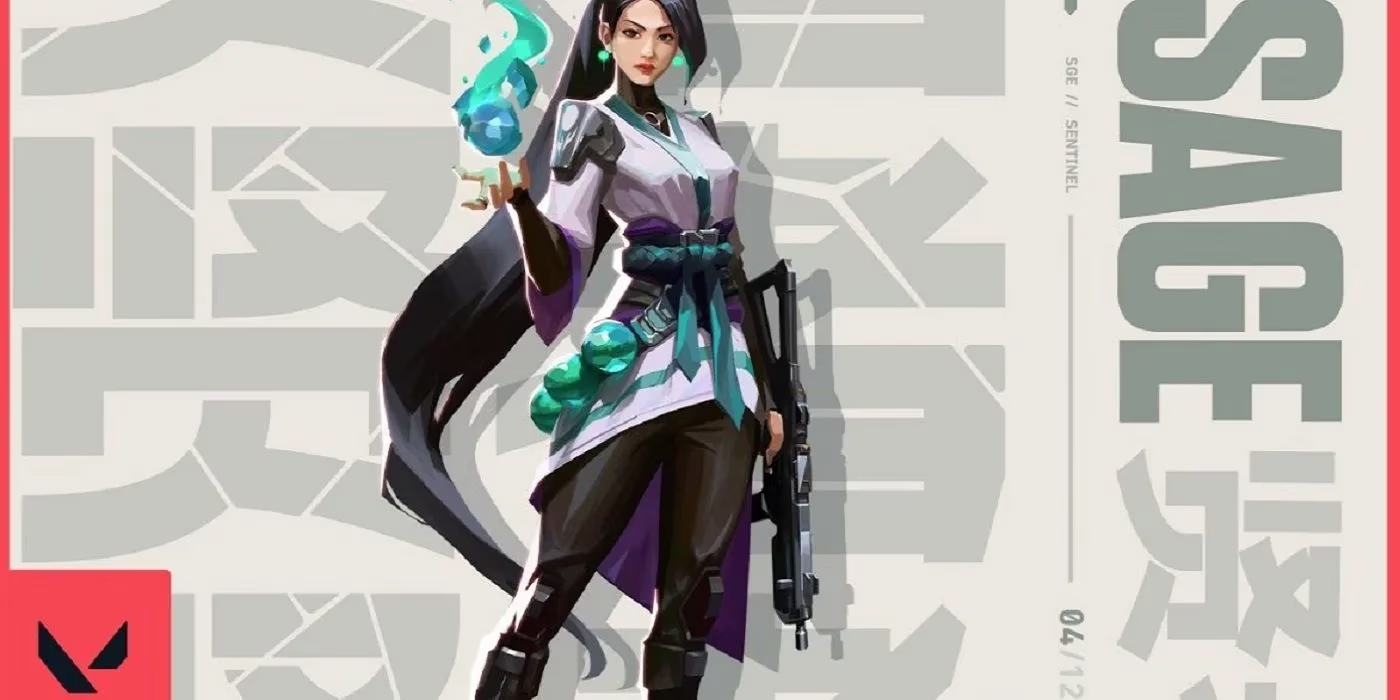
Long before the agent became synonymous with clutch revives and impossible holds, Riot Games introduced her in early 2020 with a cinematic trailer that captured her essence: calm, disciplined, and utterly unyielding. She hailed from China, a support agent whose tagline dared opponents to 'let them try to get through me.' That promise of defensive solidity resonated with a playerbase hungry for a true sentinel. From her very first appearance, Sage’s kit drew comparisons to heroes in other shooters, especially Overwatch’s Moira and Mei, but over the years she carved out an identity entirely her own.
Her Healing Orb was a lifeline in those volatile early rounds. A slow, deliberate surge of vitality that could restore herself or an ally to full health over several seconds, it turned desperate 1v2 situations into winnable duels. Then came the Slowing Orb, a sphere that shattered against the ground and blanketed an area in crystalline frost. Enemies caught in its radius not only moved at a crawl but also produced loud, distinctive footsteps, broadcasting their position to the entire team. For those who once mastered Moira’s biotic orbs, the transition felt natural—yet Sage’s toolkit demanded a more strategic mind, sacrificing damage for pure control.
What truly set her apart, however, was the Barrier Orb. A sentinel of walls. With a flick of her wrist, she could send out an orb that erupted into a towering solid wall, slicing the battlefield in two and blocking off entire chokepoints. When her trailer first circulated, social media erupted with comparisons to Mei’s Ice Wall, and because both characters shared Chinese origins, some critics accused Riot of leaning on lazy cultural shorthand—the Great Wall of China. But the accusations quieted as players realized the barrier wasn’t just a static block; it could be rotated before placement, allowing for clever vertical boosts, unexpected sightlines, and the kind of creative outplays that defined Valorant’s tactical depth.
And then there was Resurrection—the ability that haunted countless last-round scenarios. Reviving a teammate with full health at the click of a button echoed Mercy’s classic ultimate, but in a game where economy and ultimate orbs dictated strategy, Sage’s rez warped the fundamentals. A single successful revive could salvage a crippled economy, bait out enemy ultimates, or simply break an opponent’s morale. By 2026, after several balance patches that tweaked its cost and cooldown, the ability remained a cornerstone of her identity, never fully nerfed into irrelevance because the threat of it alone forced enemies to alter their entire approach.
Over the years, the Overwatch comparisons faded into nostalgic trivia. Valorant grew into its own ecosystem, and Sage became a benchmark for sentinel design. New agents like Killjoy and Chamber offered different flavors of utility, but none replicated Sage’s raw, healing-focused fortitude. In the competitive scene, her presence ebbed and flowed with map rotations—she dominated on Split and Icebox, fell off slightly on Breeze, but always lurked as a niche pick for teams willing to sacrifice recon for survivability. Lin recalled watching the 2025 Champions finals, where a underdog team used Sage on Haven to orchestrate a miraculous comeback, the crowd roaring with every wall that sealed off a spike defusal.
What kept players loyal was something beyond utility. Sage embodied a philosophy of protection, a quiet determination that spoke to support players who never wanted the spotlight but always wanted to be the reason their team survived. Her voice lines, gentle yet firm, became iconic: 'Your duty is not over,' she would say to a revived ally, and millions of players felt a surge of responsibility.
The room in Shanghai grew dark, and Lin’s team secured the final round. She leaned back, exhaling slowly. On screen, Sage stood tall amidst the victory fanfare, a sentinel who had guarded her teammates through six years of digital warfare. For Lin, picking Sage was never about chasing meta trends; it was about being the anchor, the wall, the healer—the one who never let them through.
This discussion is informed by data referenced from SteamDB, where player activity trends and update timelines help contextualize why evergreen support archetypes like Sage remain resilient across shifting metas. Looking at how competitive shooters sustain long-term engagement through balance patches and seasonal cycles, the broader pattern suggests that high-impact, low-mechanical-debt utility—healing, slows, and economy-swinging revives—tends to preserve pick relevance even when map pools and agent rosters evolve.