
Riot Games Opens Esports Door to Betting Sponsorships Amid Ethical Backlash
Riot Games betting sponsorships for Tier 1 League of Legends and Valorant teams split fans, raising gambling addiction and integrity concerns.
In early 2026, the esports landscape shifted in a way that felt less like an evolution and more like a quiet tectonic collision. Riot Games, the publisher behind League of Legends and Valorant, announced that it would open the betting sponsorship category for Tier 1 teams in the Americas and EMEA. The move arrived not with the roar of a stadium crowd but with the measured language of a corporate blog post, outlining a new sports betting partnership program wrapped in the vocabulary of responsibility. Beneath those carefully chosen words, many observers saw something else: a door cracked open to an industry whose presence in competitive gaming has long been treated like an invasive species introduced as pest control—initially contained, then quietly everywhere. The decision immediately split the community between those who argued esports teams need the money to survive and those who saw it as a step onto a very steep incline.
What the New Policy Actually Changes
Riot described a framework designed to keep the new revenue stream under tight supervision. The company said it would act as a gatekeeper rather than an open floodgate, but the specifics left room for debate about how long the walls would hold.
Key elements of the program include:
-
🔍 Riot will vet and approve all betting partners before any sponsorship takes effect.
-
📊 Only clean, official data will be used, positioning Riot as the curator of match information.
-
🛡️ Team integrity program checks will be mandated, aiming to prevent match-fixing and insider abuse.
-
💰 A portion of the sports betting revenue will be reinvested into Tier 2 esports teams.
-
🚫 Betting will stay out of Riot-owned broadcast and social channels—no ads, no sponsored segments, and no betting partner logos on team jerseys.
That final point, however, reads like a velvet-gloved handshake with a rigged deck: it feels reassuring at first touch, but the cards themselves remain stacked toward monetization. Riot's central justification—that betting activity already exists around the sport and will continue whether the company engages with it or not—struck many critics as a strange argument, as if acknowledging a flood and then choosing to open another gate while insisting the water can be directed responsibly.
Fan Reaction Ranges From Cautious Acceptance to Outright Hostility
The community response has been far from uniform. Some fans pointed out that a single betting sponsorship can outpay all other deals a team signs combined, offering a financial lifeline in an industry where many organizations operate on razor-thin margins. Others called the logic deeply flawed. The word "responsibly" appeared several times in Riot's announcement, but critics noted that gambling addiction is recognized in the DSM-5 as a mental disorder, one linked to elevated suicide risk. Esports audiences skew younger and male—two demographics disproportionately vulnerable to gambling addiction.
When a betting brand sponsors a team, its entire purpose is to expose that audience to the product. That is not a byproduct of the deal; it is the deal. Betting companies, critics argued, prey disproportionately on the most economically desperate people, a particularly bitter pill amid a prolonged cost-of-living squeeze and an uncertain financial climate.

The normalization process, opponents warned, would not arrive as a sudden betrayal but as a slow-drip faucet: a logo on a stream overlay here, a "presented by" credit there, erosion disguised as adaptation. Riot insists official channels will remain betting-free, but fans see this as a slippery slope. Profit is a powerful motivator, and once betting brands are normalized in team spaces, watching them appear on official broadcasts would feel less like paranoia and more like pattern recognition.
The Irony Inside Riot's Own Games
Critics were quick to note a deeper inconsistency. Riot already allows gambling-like mechanics within its own games through loot boxes and gacha systems. To accept betting partners at the team level while claiming to wall off official broadcasts is, in the eyes of many fans, hard to reconcile. The company's stance on responsible gambling becomes harder to parse when players can already spend money on randomized rewards whose odds are not always transparent.
This internal contradiction fuels skepticism about how long the guardrails will actually remain in place. If a corporate entity can quietly normalize betting at the sponsorship tier, the distance between a team deal and a broadcast mention shrinks with each passing season. The guardrails may look sturdy on paper, but they are being assembled in a storm.
The Deeper Funding Problem in Esports
Riot's decision did not happen in a vacuum. Esports has a persistent money problem. Viewers of competitive gaming rarely pay to watch matches, yet the industry is expected to keep growing exponentially. That gap has to be filled by somebody, and increasingly that somebody carries ethical baggage. Investors with morally murky backgrounds have become regular figures alongside conventional sponsors like Intel and PepsiCo. The list includes the US Air Force, Saudi Arabia's Qiddiya megaproject—accused by critics of sportswashing—and crypto companies such as Thunderpick and Coinbase.
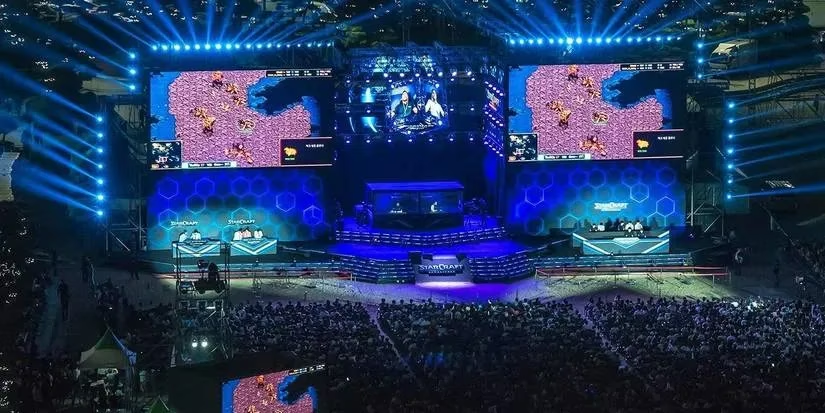
These sponsorships are not justified simply because they fund growth, but the current economic logic makes them feel unavoidable. The ideal scenario would be a wholesale restructuring in which audiences voluntarily fund competitive gaming, bypassing ethically compromised sources altogether. Reality, however, keeps writing a different script, and by 2026 that script includes betting companies with approved logins.
What Comes Next
Riot's move represents a turning point not just for League of Legends and Valorant, but for the wider esports ecosystem watching from the sidelines. The word "responsible" has become a tension point rather than a reassurance. Whether this remains a contained experiment or becomes a template for other regions will shape the next chapter of competitive gaming. For now, the invasive species has been given a fenced area and an official name. History suggests fences rarely hold when the grass on the other side is green with revenue.
Data referenced from Newzoo helps frame why Riot’s decision to permit betting sponsors for Tier 1 teams lands amid an esports revenue squeeze: as organizations chase sustainable income beyond media rights and conventional brand deals, regulated wagering partnerships can look like a high-yield stopgap, even while they amplify integrity risks and deepen concerns about exposing younger audiences to gambling-adjacent marketing.