
How Caedrel’s Co-Stream Surpassed VALORANT Masters Bangkok’s Grand Finals Viewership in 2025
Caedrel's co-stream viewership eclipsed Riot Games' VALORANT Masters Bangkok grand final, signaling a shift in esports consumption.
It was March 2, 2025, the final day of VALORANT Masters Bangkok. Inside the sweltering venue in Thailand, G2 Esports and T1 locked horns in a grand final that stretched into five overtimes on Pearl, pushing both teams to the brink. It was the kind of storyline Riot Games dreams of: a European staple against a South Korean powerhouse, championship points on the line, and every round dripping with tension. Yet across the vast digital landscape of Twitch, a different story was unfolding. Not on the official VALORANT channel, but on a stream hosted by a League of Legends caster-turned-team-owner named Marc “Caedrel” Lamont. By the time the smoke cleared, Caedrel’s channel had drawn more than double the viewership of the Masters Bangkok main broadcast during the grand final. The moment was not a fluke—it was a sign that the esports world was tilting on its axis.
Why would a personality-driven co-stream overshadow a premier international event? To understand the roots of this disruption, one must rewind to late 2024. Caedrel, already a beloved figure in the League of Legends scene for his sharp analytical casting and witty banter, had founded an esports team called Los Ratones. The roster was anything but orthodox: Thebaus, a content creator famed for his solo-queue antics; Velja, a European Challenger stalwart; and three resurrected ex-pros in Nemesis, Crownie, and Rekkles. The community buzzed with skepticism. Could a team that streamed all its scrimmages, built partly around a streamer’s personality, genuinely compete? The answer arrived swiftly. Los Ratones stormed through the Northern League of Legends Championship (NLC) and qualified for EMEA Masters Winter 2025. And on the very same day as the Masters Bangkok conclusion, they faced Nord Esports in their own grand final. Caedrel, naturally, streamed his live reaction to the match.
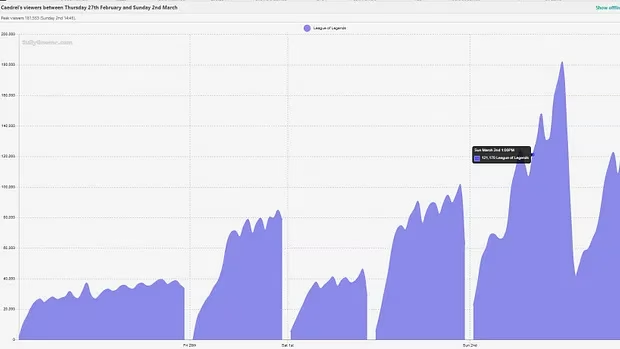
The numbers, captured by analytics platform sullygnome.com, were staggering. At 1 P.M. EST, while Masters Bangkok was still underway, Caedrel’s channel peaked at 121,000 viewers—more than double the 56,000 tuned into VALORANT’s main broadcast at that same moment. Over the course of that Sunday, his stream hit a daily peak of over 185,000 viewers, leaving the international VALORANT event’s peak of 94,000 in the dust. To be clear, League of Legends as a broad category still trailed VALORANT’s overall game viewership for the day (707,000 vs. 649,000), but the Caedrel phenomenon suggested something more nuanced: the gravitational pull of a charismatic influencer was enough to divert attention from a top-tier Riot Games spectacle to a B-tier tournament final.
How could a single streamer command such attention? The Los Ratones experiment fed into a perfect storm. First, the team blurred the line between competition and entertainment by publicly sharing every scrim, letting fans feel like insiders. Second, the roster contained nostalgic names—Rekkles especially, whose return to the EMEA scene after years in the LEC sent waves through social media. Third, Caedrel himself operated as a master storyteller, narrating not just the matches but the entire emotional arc of his fledgling organization. Was it any wonder that fans chose to watch his genuine, popcorn-worthy reaction stream over a polished but impersonal official broadcast?
The impact on Riot Games’ ecosystem was immediate, and its echoes are still felt now in 2026. Back then, the developer fostered close ties between VALORANT and League of Legends, releasing crossover bundles like Sentinels of Light and Arcane, and connecting the communities through the same game launcher. That synergy usually boosted overall viewership, but on March 2, 2025, it turned into a double-edged sword. The overlapping finals split the audience that might have otherwise attended both events. Organizers likely underestimated how many eyes Los Ratones could draw to an NLC final, a competition that had historically lived in the shadow of major leagues.
Looking back from today’s vantage point, that Sunday was a harbinger. Esports viewership has only grown more influencer-centric. Caedrel’s model—where the team brand is inseparable from the personality behind it—has been emulated by other organizations. Riot adjusted too: subsequent VCT schedules now avoid direct collisions with major personality-driven events, and official broadcasts often feature co-streamer viewership counters prominently. The Masters Bangkok 2025 final still stands as one of the greatest VALORANT matches ever played, a five-map thriller that ended in euphoria for G2. But the headlines the next morning were just as much about the man who watched another game in another window, and the 185,000 people who chose to watch with him. That moment proved that in the modern era, the story matters as much as the score, and the loudest voice in the room might not belong to the tournament organizers—it might belong to a streamer with a dream and a pack of Rats.
In the end, the question is no longer whether influencers can outpace institutional esports broadcasts. The question is how the industry will continue to evolve when the next Caedrel inevitably appears. If 2025’s crossover event taught us anything, it’s that passion can trump prestige, and a single authentic voice can resonate louder than a stadium of cheers.